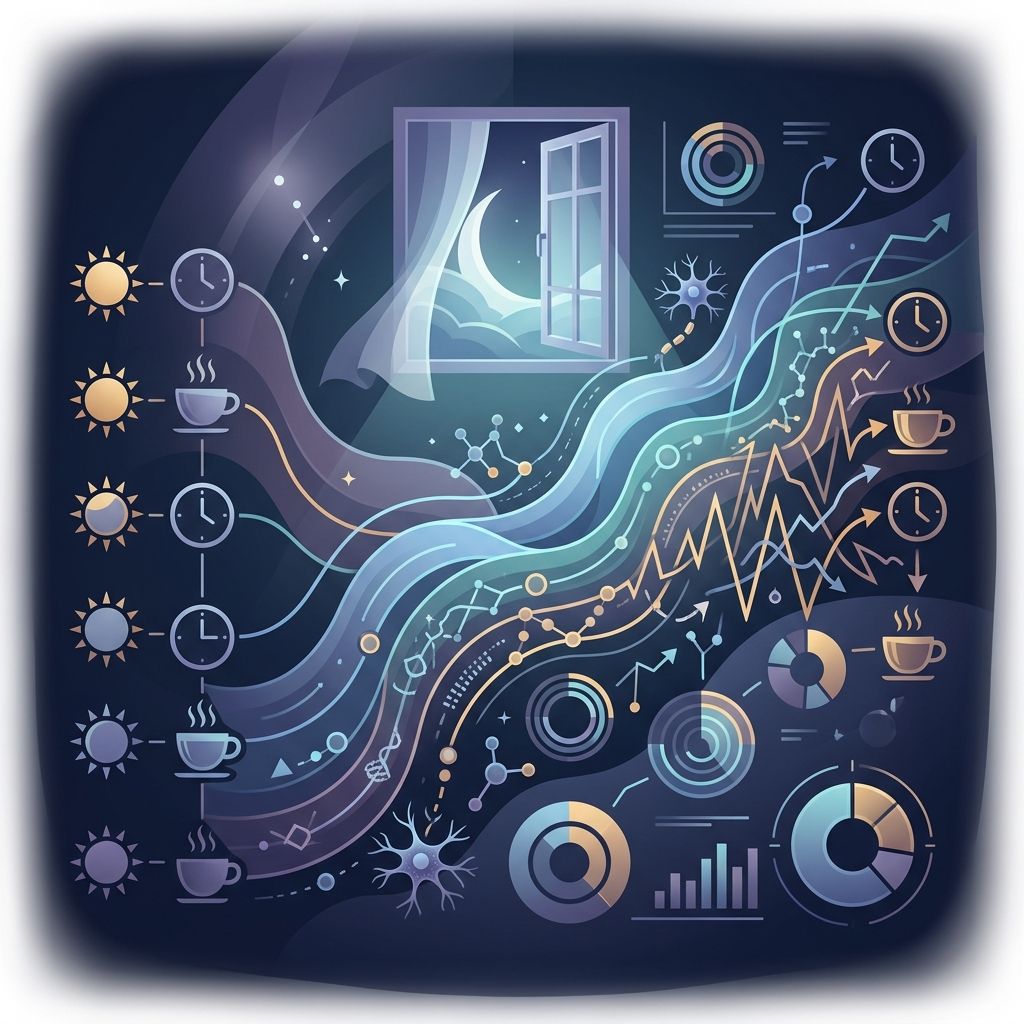
Caffeine Timing: How Late Coffee Steals Deep Sleep
"Coffee doesn't affect me — I can drink an espresso and fall right asleep." Perhaps you can. But falling asleep was never the whole story. Caffeine's quieter effect is on the architecture of sleep itself, thinning the deep, restorative stages even in people who drift off without difficulty. The good news: you rarely have to give up coffee. You mostly have to move it.
How Caffeine Works: Borrowing Against Sleep Pressure
From the moment you wake, a molecule called adenosine accumulates in your brain — the biochemical signature of time spent awake, and the driver of the sleep pressure that eventually pulls you under at night. Caffeine works by impersonation: its structure is similar enough to adenosine that it slots into the same receptors without activating them, blocking the sleepiness signal from being received.
Crucially, caffeine does not erase adenosine — it only hides it. The molecule keeps accumulating behind the blockade, which is why the "crash" arrives when caffeine wears off: the full backlog of sleepiness lands at once. Caffeine is not energy; it is a loan against your own sleep pressure, repaid with interest.
The Half-Life Problem
Caffeine's half-life — the time your body needs to eliminate half of a dose — runs roughly five to six hours in most adults, with wide individual variation. Run the arithmetic and the afternoon habit looks different: a 200 mg coffee at 3 p.m. leaves something like 100 mg on board around 8 to 9 p.m., and still 50–65 mg past midnight. Fifty milligrams is about half a cup of coffee — the equivalent of drinking half a cup as you turn out the lights.
Some people clear caffeine notably faster or slower than average; genetics, certain medications, pregnancy, and liver function all shift the pace. Sleep also grows lighter and more easily fragmented with age, so a dose that never bothered you at twenty-five may fray your sleep at forty-five — the coffee did not change; the sleep around it did.
The Stealth Effect: What Late Caffeine Does to Deep Sleep
Here is why "I fall asleep fine" is false reassurance. Even when caffeine on board does not delay sleep onset, research on sleep architecture shows it tends to reduce slow-wave sleep — the deepest stage, when the body does much of its physical restoration and the brain consolidates the day. It can also fragment the night with brief arousals you never remember.
The result is a night that looks normal in length but runs shallow, and a morning that feels inexplicably unrefreshed — which invites more coffee, earlier and stronger, which further shallows the following night. Many people live for years inside this quiet loop, blaming stress or age for a fatigue that is at least partly on the schedule of their own café orders.
Timing It Right — Without Giving Up Coffee
A sensible, evidence-aligned rule of thumb: place your caffeine cutoff eight to ten hours before bedtime. For someone sleeping at 11 p.m., that means the last cup lands between 1 and 3 p.m. Sensitive sleepers, and anyone actively working on insomnia, often do best keeping caffeine to the morning only.
Mind the hidden sources, too. Black and green tea, cola and many other sodas, energy drinks, pre-workout supplements, dark chocolate, and some pain relievers all carry meaningful caffeine. Decaf is not zero, though it is modest. An honest afternoon audit sometimes reveals a surprising evening total from sources that never felt like "coffee."
If you are cutting back, taper rather than quit cold — stepping down gradually over a week or two, or shifting to half-caf, spares you the withdrawal headache and the rebound fatigue that make people abandon the experiment.
Caffeine and Insomnia: Necessary but Not Sufficient
One honest caveat: if you have chronic insomnia, fixing caffeine timing alone probably will not resolve it. Established insomnia runs on conditioning, scheduling, and sleep effort — which is why structured CBT-I is the recommended first-line treatment. Think of caffeine timing as clearing a saboteur from the room so the real work can succeed. And if you rely on heavy caffeine to survive severe daytime sleepiness — especially alongside loud snoring or breathing pauses at night — talk with your clinician, since that pattern can signal sleep apnea rather than a coffee problem.
Key takeaways
- Caffeine blocks adenosine, masking sleep pressure rather than eliminating it.
- Its half-life is roughly five to six hours, so afternoon doses linger at bedtime.
- Late caffeine tends to trim deep slow-wave sleep even when you fall asleep normally.
- A cutoff eight to ten hours before bed protects most sleepers; taper rather than quit abruptly.
- Watch hidden sources: tea, sodas, energy drinks, chocolate, and some medications.
Frequently Asked Questions
How much caffeine is safe per day?
For most healthy adults, moderate intake — commonly cited as up to about 400 mg daily, roughly three to four cups of coffee — is considered reasonable. Timing often matters more for sleep than total amount, and pregnancy or heart conditions warrant a conversation with your clinician.
Why can some people drink espresso after dinner and sleep fine?
Genetic differences in caffeine metabolism are substantial — fast metabolizers clear a dose in a fraction of the time slow metabolizers need. Some late drinkers are also sleeping worse than they realize, since caffeine's deep-sleep effects do not always announce themselves.
Does switching to tea in the afternoon solve the problem?
It helps but does not eliminate it. A cup of black tea carries roughly half the caffeine of coffee, and green tea less still — meaningful reductions, but the half-life math applies to every milligram. Herbal infusions like chamomile or rooibos are the truly caffeine-free route.
Rebuild Deeper Nights With SnoozeSync
SnoozeSync helps you see the whole picture — your caffeine habits, your sleep window, and your night-to-night patterns — inside a structured CBT-I-based program with gentle daily coaching. Small timing changes, tracked honestly, add up to noticeably deeper nights for many people. See what your afternoons are doing to your nights: try SnoozeSync.
Start Free 2-Week TrialPhysician-designed CBT-I. No credit card required to begin.